UPI fraud in 2026: the new tricks and how to stay safe
UPI frauds are mostly small, fast and avoidable. Here are the tricks doing the rounds in 2026, the rule changes that help, and exactly what to do in the first hour if money goes.
By Shashi Kumar ·
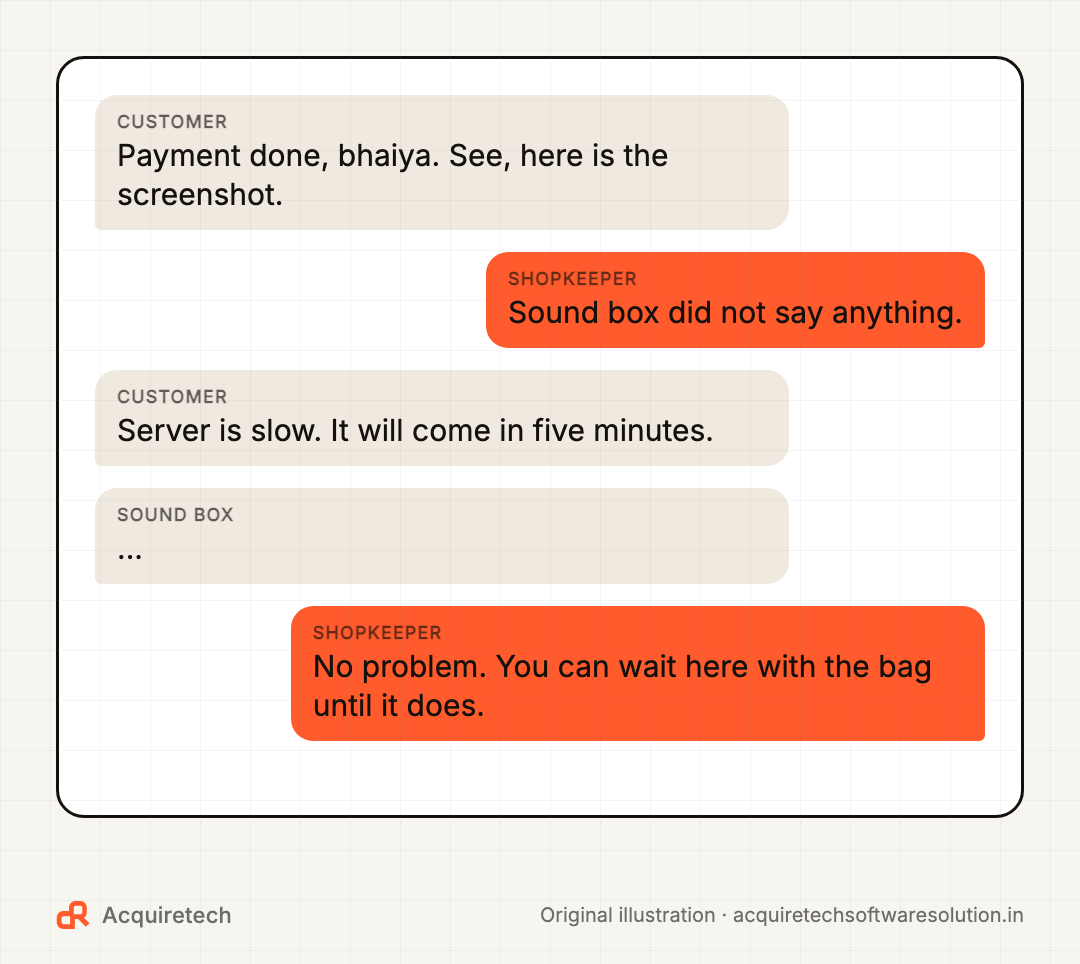
A customer at a phone-recharge counter flashes a "payment successful" screen, complete with a green tick and a transaction ID. The shop is busy, the queue is long, and the shopkeeper nods him through. The money never arrives, because it was never sent.
That is UPI fraud in 2026: rarely clever hacking, usually a small, fast trick played on someone busy, kind or worried. Almost every version breaks on one rule: a payment is only real when it shows up in your own bank or UPI app.
Here are the current tricks, the rule changes that help, and what to do in the first hour.
How big is UPI fraud?
The Ministry of Finance told the Rajya Sabha that more than 16.3 lakh UPI fraud cases involving about ₹1,226 crore were reported in 2025-26 up to 15 March 2026, according to Informist. Earlier replies, reported by The Hans India, put 2023-24 at 13.42 lakh cases (₹1,087 crore) and 2024-25 at 12.64 lakh cases (₹981 crore).
Cases are rising again, and the average case is small, roughly ₹7,500 by our arithmetic, which is why many victims never report. The big-ticket losses sit in investment and "digital arrest" scams.
Fast reporting genuinely works. The Ministry of Home Affairs told Parliament on 21 July 2026 that more than ₹11,158 crore had been saved across more than 32.8 lakh complaints through the 1930 reporting system as of 30 June 2026.
What changed in the rules
The first change matters most: since 1 October 2025, an ordinary person cannot send you a UPI collect request. If a "request" claims a stranger wants to pay you, something is wrong.
The tricks doing the rounds in 2026
1. "Scan to receive" QR codes and payment links
With collect requests gone, fraudsters send QR codes or links: "Scan this to receive your refund." Scanning a QR and entering your PIN or biometric always sends money. To receive money, you only ever share your UPI ID or number.
2. Fake screenshots, prank apps and spoofed SMS
PhonePe's merchant guidance lists edited screenshots, counterfeit apps that show convincing success screens and transaction IDs, and fake "credited" SMS messages. It also warns that a notification sound alone does not confirm payment, since anyone can play one from their phone.
Genuine commercial SMS now carry a sender-ID suffix such as -T (transactional) or -S (service), which operators began adding in May 2025. A "bank" SMS from a plain mobile number is a red flag, but even a well-formatted one is not proof. Check your bank app.
3. QR sticker swaps
Someone pastes their own QR code over a shop's, or a fake "parking" or "donation" QR appears on a wall. When you scan, your app shows the receiving name. Read it before you pay.
4. Screen-sharing and remote-access apps
"Your KYC has expired" or "let us process your refund" calls end with a request to install a screen-sharing app. The caller then watches you type your PIN and OTPs. No bank needs to see your screen.
5. "Wrong transfer, please return it"
Someone sends you money, or claims to, then asks you to return it to a different number. The credit may be fake, or real money stolen from another victim, which can get your account frozen: the MHA reports more than ₹8,189 crore marked as lien between 2021 and 2025. Do not send it back yourself. Tell them to go through their bank, and inform yours.
6. Fake customer-care numbers
Fake helpline numbers for banks, UPI apps and delivery firms appear in search results, ads and comments. Get support numbers only from the official app or your card.
7. Mule account offers
"Earn ₹5,000 a month by letting us use your bank account." Rented accounts launder fraud money, and their owners risk frozen accounts and police cases.
8. Festive offers and too-good deals
Sale season brings fake shopping sites, "lucky draw" links and cashback forms that end in a PIN prompt. Our guide to spotting fake apps covers the app-store version of the same trick.
Real or fake? Test yourself
Lost money? What to do in the first hour
- Call 1930 or report at [cybercrime.gov.in](https://cybercrime.gov.in/) immediately. This starts the process of freezing money in the receiving accounts. Minutes matter.
- Call your bank using the number in its app or on your card, and ask it to block UPI on the account. If your UPI app already offers the MyUPI Safety Switch, use it too.
- Save evidence: the 12-digit UTR, screenshots, the scammer's number, UPI ID and chat.
- Report the number or message on the Sanchar Saathi Chakshu facility.
- Put it in writing to your bank and keep the complaint number.
What the bank owes you depends on how the fraud happened. Under the RBI's 2017 rules, still in force, you have zero liability if the fraud was the bank's fault, or a third-party breach you reported within three working days. But if you were tricked into entering your own PIN, banks usually treat it as customer negligence, and you bear the loss until you report it.
From 1 January 2027, the RBI's new directions change that. As summarised by Upstox, victims who lose up to ₹50,000 and report to both their bank and 1930 or the portal within five calendar days can get 85% of the net loss, capped at ₹25,000, once in a lifetime. Banks must also resolve fraud complaints within 45 days. If your bank does not resolve a complaint, you can escalate it on the RBI's complaint portal, cms.rbi.org.in.
For shopkeepers accepting UPI
- Trust only your own device. Confirm the amount and UTR in your app or on your sound box, never on the customer's phone.
- Listen to your sound box, not their phone. A payment tone can be played from any phone.
- Check your QR sticker every morning and use a standee that shows your registered business name.
- Never scan a customer's QR to "receive" money, and never refund a "wrong transfer" to a new number.
- Keep a separate account for the shop and never let anyone "borrow" it.
- Train everyone at the counter. Fraudsters target the busiest hour and the newest staff member.
Setting up a small shop? See our list of free apps for small businesses in India.
Frequently asked questions
Do I need to enter my UPI PIN to receive money?
No. You never need your UPI PIN, fingerprint or face to receive money. Any QR code, link or request asking you to approve something in order to receive a payment is a scam.
Can someone still send me a UPI collect request in 2026?
Not as a private person. NPCI switched off person-to-person collect requests from 1 October 2025, so payments between individuals must be started by the payer. Merchants can still send payment requests, so read the payee name before approving anything.
How do I check if a UPI payment is real?
Confirm the amount, time and UTR in your own bank or UPI app, or on your own sound box. Screenshots, SMS messages and sounds from someone else's phone prove nothing.
What should I do immediately after a UPI fraud?
Call the 1930 helpline or report at cybercrime.gov.in at once, then call your bank to block UPI. Save the UTR and screenshots, and file a written complaint with your bank.
Will my bank refund money lost to UPI fraud?
It depends on the case. Under current RBI rules you get zero liability for bank errors or third-party breaches reported within three working days, but losses from sharing your PIN are usually yours. From 1 January 2027, a new RBI scheme can compensate up to ₹25,000 for small frauds reported within five days.
The bottom line
UPI is not the weak point; the moment of pressure is. Read the payee name, never enter a PIN to receive, trust only your own app, and call 1930 the moment something goes wrong.
Most of these tricks rely on the same psychological levers as every other scam. Our explainer on why smart people fall for scams shows how they work, and our guide to the digital arrest scam covers the biggest-ticket version.
Sources and further reading
- National Cyber Crime Data · Press Information Bureau (Ministry of Home Affairs) · 2026-07-21
- UPI Fraud: Over 1.6 mln UPI fraud cases involving INR 12 bln reported in so far in FY26 · Informist Media · 2026-03-24
- UPI frauds worth Rs 805 crore witnessed this fiscal so far: Minister · The Hans India · 2025-12-15
- NPCI to End UPI P2P Collect Requests from October 1 to Reduce Fraud · Outlook Money · 2025-08-16
- UPI biometric payments: India goes PIN-free with face or fingerprint scans · The Federal · 2025-10-11
- NPCI notified regarding the enhancement of transaction limit for On-Device Biometric Authentication in UPI · TeamLease RegTech · 2026-07-03
- MyUPI Launched With AI-Powered Support For UPI Users · Outlook Money · 2026-09-20
- RBI Issues Amendment Directions on 'Review of Framework of Limiting Customer Liability in Digital Transactions' · Reserve Bank of India · 2026-06-24
- 7 most important points from new RBI rules to help online fraud victims from January 1, 2027 · Upstox · 2026-06-27
- Customer Protection – Limiting Liability of Customers in Unauthorised Electronic Banking Transactions · Reserve Bank of India · 2017-07-06
- Fake UPI Payment Scams: How to Identify and Prevent Fraud · PhonePe Business · 2026-09-01
- Will Telcos Adding Suffixes to Commercial SMS Headers Help Curb Spam? · MediaNama · 2025-05-20
Contact Acquiretech Software Solution: info@acquiretechsoftwaresolution.in · WhatsApp +91 80786 33912 · Send an enquiry