Deepfake voice calls: check a "family emergency" call in 30 seconds
The voice sounds exactly like your son, or your boss. AI voice cloning makes that cheap. Here is how it works, real cases from India and abroad, and a 30-second check that beats it.
By Shashi Kumar ·
The phone rings from an unknown number. It is your brother's voice, the exact voice, the way he says your name. He is at a hospital, a friend needs urgent surgery, his bank account is stuck. Could you pay the doctor directly? He has already sent the money to your account; you will see the SMS.
That is almost exactly what happened to a 43-year-old school teacher in Indore in January 2026. She made four Google Pay payments totalling ₹97,500. The credit SMS was fake, the caller's number went dead, and her real brother had never called. Police suspected AI voice modulation, the Free Press Journal reported.
Cloned voices used to be a film plot. Now they are a cheap tool. The good news: the defence is old-fashioned, takes 30 seconds, and works even if you cannot tell a clone from the real thing.
How voice cloning works, in plain English
A voice cloning system is trained on huge amounts of recorded speech, so it already knows how human voices work: how sounds join, how pitch rises in a question. From you it needs only what makes your voice yours: tone, accent and rhythm.
Give it a short sample and it can do one of two things:
- Text to speech in your voice. The scammer types a script ("Mumma, I've had an accident") and the tool reads it out as you.
- Voice conversion. The scammer speaks live and the tool reshapes their voice into yours, in near real time.
Add a bad line and a crying tone, and small imperfections disappear.
How little audio is needed
Less than most people assume. In McAfee's 2023 research for its "Artificial Imposter" report, researchers said one tool produced an 85% voice match from just three seconds of audio. That is one vendor's test of one tool, not a universal law, but the direction is clear and the tools have only improved since.
The same survey found 47% of Indian adults had experienced an AI voice scam or knew someone who had, and 69% were not confident they could tell a cloned voice from a real one.
Where does the audio come from? Reels, YouTube videos, a voicemail greeting, a forwarded voice note. If your voice is public, assume it can be copied. That is not a reason to delete your life online; it is a reason to stop treating a familiar voice as proof of identity.
Real cases, in India and abroad
| Where and when | Who was impersonated | What happened |
|---|---|---|
| Indore, January 2026 | The victim's brother | ₹97,500 paid by UPI for a fake hospital emergency |
| Italy, February 2025 | Defence Minister Guido Crosetto | One businessman sent nearly €1 million; police froze it |
| Hong Kong, early 2024 | Senior staff of engineering firm Arup | HK$200 million transferred after a deepfake video call |
According to Reuters, the Italian fraudsters cloned the minister's voice and called business leaders, claiming money was needed to free kidnapped journalists. Former Inter Milan owner Massimo Moratti sent nearly €1 million before police traced and froze it.
In the Arup case, video joined voice: a Hong Kong employee joined a call with what looked and sounded like senior colleagues and sent HK$200 million (about £20 million). Arup confirmed to the Guardian that fake voices and images were used.
In India, the same idea now has a name in corporate circles. On 17 July 2026, SEBI cautioned listed companies and regulated entities about the "Boss Scam" after I4C flagged it, MediaNama reported: fraudsters pose as CEOs or MDs, sometimes using voice cloning or AI-generated video calls, and push finance staff to make urgent, confidential payments to mule accounts.
The 30-second verification routine
You do not need to detect the fake. You only need to verify the real. Here is the routine, which matches the core advice in the FBI's December 2024 public service announcement on generative AI fraud.
- Pause (5 seconds). Say: "I'll call you right back." Family will understand. A scammer will push back, which tells you something.
- Hang up and call the saved number (15 seconds). Not the number that called, not one they give you. If nobody picks up, call someone who would know: a spouse, a roommate, a colleague.
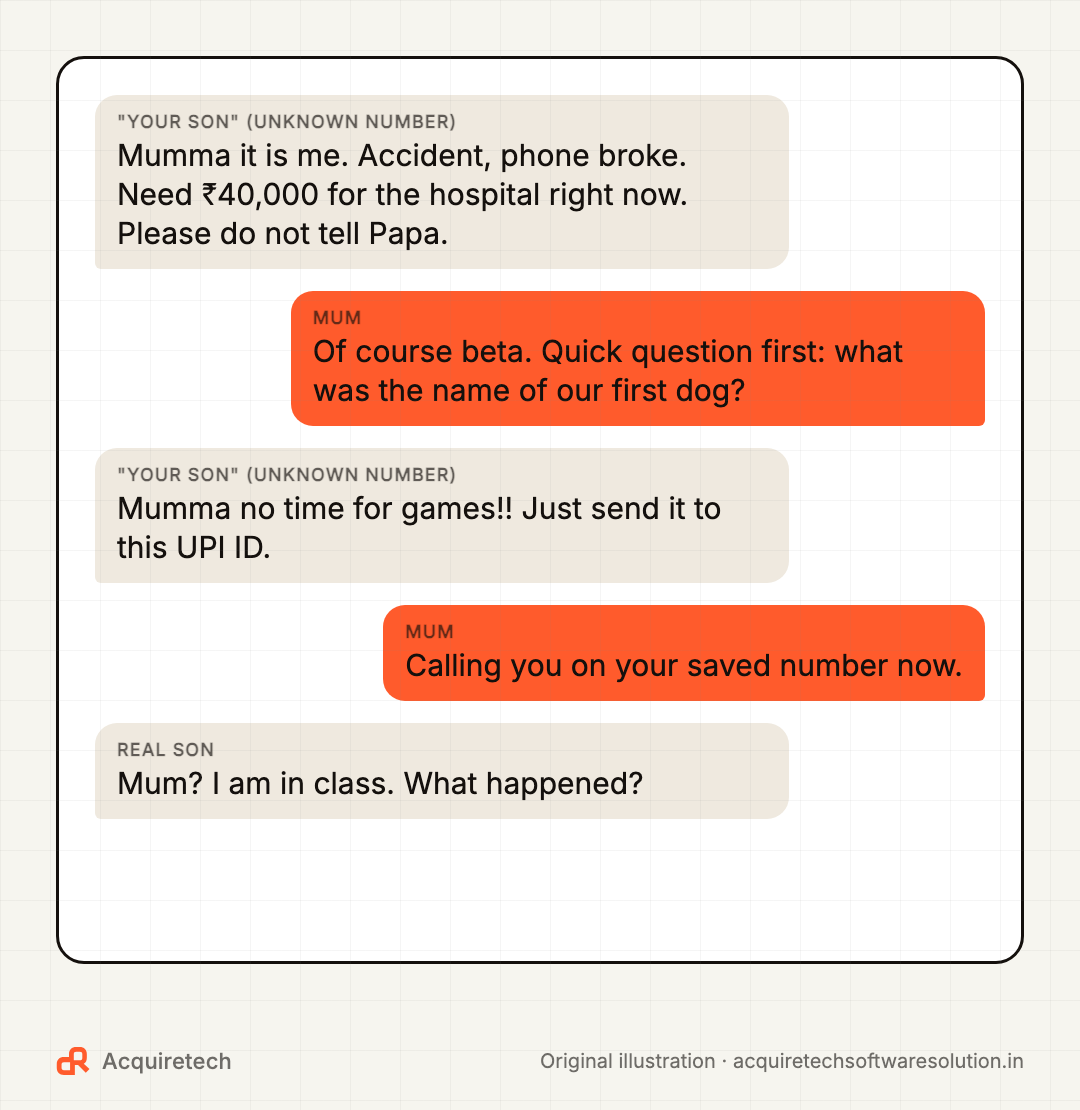
- Ask the code word, or a question only they know (5 seconds). Agree a family code word in advance and never post it. No code word yet? Ask something that is not on social media, like what you ate at a family function last month.
- Never pay under pressure (5 seconds). No gift cards, no crypto, no UPI to a new number or QR code, no "don't tell anyone". Urgency plus secrecy plus an unusual payment method is the signature of a scam.
Key point: A familiar voice is no longer proof of identity. A callback on a number you already had is.
If you think you received a scam call, report the number through Chakshu on Sanchar Saathi. If money has already moved, call 1930 immediately or report at cybercrime.gov.in, and then call your bank.
Setting up a family code word
Pick a phrase that is easy to remember and impossible to guess: not a pet's name you have posted, not a birthday. Share it in person or on a call, not in a group chat. Make the rule explicit: "Any call asking for money, from any of us, gets the code word question. No offence taken."
Elderly parents benefit most, because scammers target them most. If you already had the digital arrest conversation with them, add this to it.
Advice for businesses: make the process the defence
At work, the target is whoever can move money: an accountant, a finance manager, an office admin. Training helps, but rules that do not depend on judgement under stress help more.
- Two-person approval for any payment above a set amount, and for every new beneficiary.
- Mandatory callback. Any payment request or change of bank details received by call, WhatsApp, email or video is confirmed by calling back on a number from your own records, never one in the message.
- No "confidential" exceptions. Write it down: secrecy is never a reason to skip approval, not even for the CEO.
- Hold new payees. A short delay before the first payment to a new account gives time for checks.
- Lock down messaging. SEBI's caution, as reported, advised firms to verify instructions independently with the senior official, not to move funds on digital instructions alone, and to log out of unused WhatsApp Web sessions.
- Make saying no safe. Nobody is punished for delaying a payment to verify it, even if the request was real.
These rules work best built into the tools your team already uses, so approval cannot be skipped by accident. See our guides on human review in automated workflows and business process automation.
Frequently asked questions
How much audio do scammers need to clone a voice?
Very little. McAfee researchers reported in 2023 that one tool produced an 85% voice match from three seconds of audio. Treat any voice that is public online as copyable.
Can I tell an AI-cloned voice from a real one?
Sometimes, but not reliably, especially on a bad line or when the caller sounds distressed. Instead of trying to detect a fake, verify identity by hanging up and calling back on a number you already have.
What is a family code word and does it work?
It is a word or phrase agreed in advance that family members use to confirm identity during an urgent call. The FBI recommends creating one, and it works because a cloned voice cannot know a secret that was never posted online.
What should I do if I already paid after a fake emergency call?
Call the 1930 cyber crime helpline immediately or report at cybercrime.gov.in, then call your bank to try to stop the transfer. Keep the caller's number, payment IDs and screenshots as evidence.
How can a business protect itself from deepfake CEO calls?
Require two-person approval for large or new payments, and confirm every payment request or bank-detail change by calling back on a number from your own records. Make it a written rule that confidentiality never overrides verification.
The bottom line
You will not beat voice cloning by listening harder. You beat it by changing what counts as proof: a callback, a code word, a second approver.
Scammers mix these tricks with others, from fake job offers to fake police calls. If you want approval and callback rules built into your business tools so nobody has to remember them under pressure, talk to us.
Sources and further reading
- Criminals Use Generative Artificial Intelligence to Facilitate Financial Fraud (I-120324-PSA) · FBI Internet Crime Complaint Center · 2024-12-03
- Phone Call Scam in India: Over 45% victims of AI fraud calls lost over Rs 50,000 · Business Today · 2023-05-02
- Indore Cyber Crime: 43-Year-Old School Teacher Falls Victim To AI Voice Cloning, Loses 97k · Free Press Journal · 2026-01-08
- Italian police freeze cash from AI-voice scam that targeted business leaders · Reuters (via Yahoo News) · 2025-02-12
- UK engineering firm Arup falls victim to £20m deepfake scam · The Guardian · 2024-05-17
- SEBI warns of AI impersonation scams with fraudsters posing as company CXOs · MediaNama · 2026-07-20
- Chakshu: Report Suspected Fraud Communication · Sanchar Saathi, Department of Telecommunications · 2026-11-09
- National Cyber Crime Reporting Portal · Indian Cyber Crime Coordination Centre (I4C), Ministry of Home Affairs · 2026-11-09
Contact Acquiretech Software Solution: info@acquiretechsoftwaresolution.in · WhatsApp +91 80786 33912 · Send an enquiry