Fake job offers and interview scams in 2026: the red flags
Task scams, offer letters that cost money and video "verification" that steals your face. The red flags, the checks that take five minutes, and what employers should watch for too.
By Shashi Kumar ·
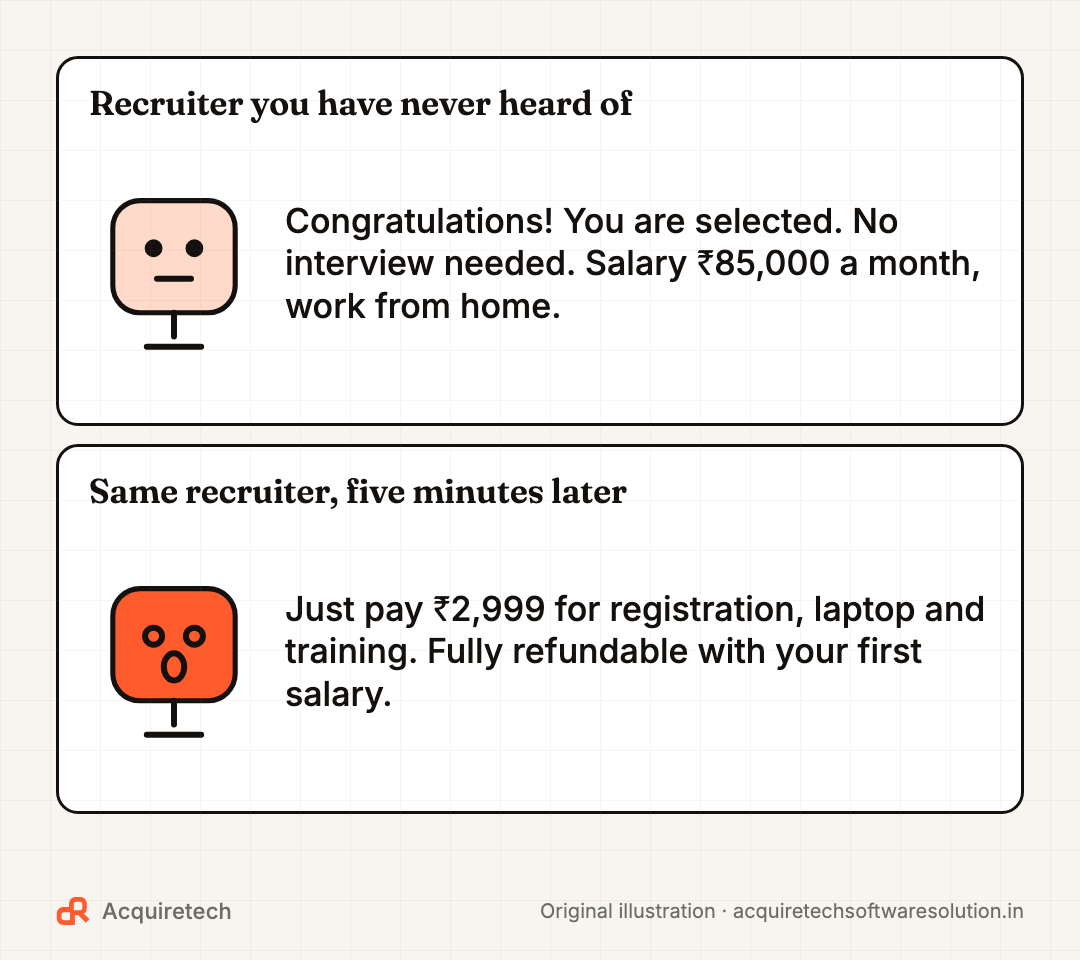
The WhatsApp message arrives at 9.40 on a Tuesday night. "Hi, I am Priya from HR. Part-time work, ₹3,000 to ₹8,000 per day, just like YouTube videos from home. Interested?"
You never applied. You have never heard of Priya. But after months of job hunting, the offer lands on a sore spot. That is the point.
Job scams have grown up. Alongside the old "pay a registration fee" trick, India's cybercrime agency now warns about fake interviews whose real purpose is to record your face. Employers face the mirror image: candidates who are not who they claim to be. Here are the variants, the red flags and the five-minute checks.
The four job scams doing the rounds
1. Task scams: "like and earn"
This is behind most of those late-night messages. In December 2023, the Home Ministry described the pattern when over 100 websites were blocked on I4C's recommendation: ads targeting searches like "ghar baithe job", a chat on WhatsApp or Telegram, then simple tasks such as liking videos or rating places on maps.
The first tasks pay a small, real commission. Then you are asked to deposit money for bigger returns. Once the deposits get large, they are frozen and the group goes quiet. The Ministry said retired employees, women and unemployed youth were the main targets.
It is global. The US Federal Trade Commission reported in December 2024 that task scam reports rose from zero in 2020 to about 20,000 in the first half of 2024. Its advice: anyone asking you to pay to unlock earnings is running a scam.
2. Offer letters that cost money
A polished PDF on a letterhead, a salary well above market, no real interview, and then the catch: a fee for registration, training, a laptop, "document verification" or a security deposit. Refundable, of course.
In May 2026, Delhi Police arrested 14 people in a case linked to over ₹8 crore in fraud transactions, PTI reported. Victims were shown fake company profiles and appointment letters, then asked for registration charges, security deposits and task fees before being blocked.
3. Fake recruiters on WhatsApp and Telegram
A stock photo, a Gmail address and a sense of urgency. They move you off LinkedIn or the job portal onto a messaging app with no moderation. The endgame is a fee, or getting you to "receive salary" and forward money, which quietly makes you a money mule.
4. Fake interviews that collect your face
The newest and most worrying. I4C's National Cybercrime Threat Analytics Unit (NCTAU) issued an alert on fake online interviews and AI-enabled biometric scams, reported by ANI on 29 May 2026.
According to officials quoted, candidates have been asked to complete video "verification" involving facial recognition or eye scanning. Officials said these biometric inputs are allegedly used to gain unauthorised access to identification systems, including altering mobile numbers tied to official ID documents. The alert also flags instant selection and pressure to finish verification quickly.
You can change a password. You cannot change your face.
The red-flag checklist
If you see two or more of these, stop.
- You were "selected" for a job you never applied for, with no real interview.
- The pay is far above market for very little work.
- Contact is only on WhatsApp or Telegram, from a personal number.
- The email is from Gmail or a domain almost, but not quite, the company's.
- You are asked to pay anything: registration, training, equipment, a deposit.
- You must deposit money to "unlock" earnings or reach the next level.
- You are asked to install an app, share your screen, or do face or eye scans via a link the company's website does not mention.
- Everything is urgent: "offer valid for 2 hours".
- You are asked to receive money and forward it.
What legitimate employers never ask for
Real employers do collect documents, usually after an offer and through their own HR process: PAN, a salary account number, certificates. What they never ask for:
| Never asked by a real employer | Why scammers want it |
|---|---|
| Any fee, deposit or "refundable" charge | It is the scam itself |
| OTPs, UPI PIN, net banking login | Direct access to your money |
| Aadhaar face or iris scan on a random app or link | Identity theft, SIM and account takeover |
| Remote-access or screen-sharing apps | Control of your phone |
| Receiving and forwarding money | Turns you into a money mule |
For a genuine employer, UIDAI's masked Aadhaar, which hides most of the number, is usually enough.
Real employers, including us, never charge applicants and list openings on their own website. Ours live only on our careers page.
How to verify a company and a recruiter in five minutes
- Find the company yourself. Search for its official website, not the link in the message, and check the role is on its careers page.
- Check the email domain. Look for extra letters, hyphens or a different ending.
- Look up the recruiter. Real recruiters have a LinkedIn history and colleagues at the company. A month-old profile with 12 connections is a warning.
- Call the company on a number from its website. Ask HR whether the person and the offer exist.
- Check the company is real. In India, search its registration on the Ministry of Corporate Affairs website, then search its name with "scam".
- Never pay to proceed. If a step costs money, verification is complete: it is fake.
The reverse risk: fake candidates
Employers hiring remotely face the other side of the problem. In October 2026, the US Justice Department said North Korean IT workers using stolen identities had infiltrated at least 70 US companies, with authorities searching more than 40 suspected "laptop farms" in Texas, according to TechCrunch. And research firm Gartner has predicted that by 2028, around 1 in 4 candidate profiles worldwide could be fake. In a Gartner survey of 3,000 candidates, 6% admitted to interview fraud, either posing as someone else or having someone pose as them.
This matters for small firms too: an agency hiring a remote developer can hand a stranger access to client code. Sensible steps:
- Hold a live video interview with follow-ups about the candidate's own work.
- Verify identity through a documented process after the offer.
- Call references on numbers you find yourself.
- Ship equipment only to a verified address, and start new hires with minimal access.
- For sensitive roles, consider an in-person or verified final round.
As in our guide to keeping a human in the loop for AI workflows: automate the screening, but keep a person accountable for the final identity check.
If you have already paid or shared documents
- Money sent? Call 1930 immediately or report at cybercrime.gov.in, then call your bank. Speed improves the chance of freezing funds.
- Shared Aadhaar or did a face scan? Report it, lock your Aadhaar biometrics through UIDAI's official channels, and watch for SIM swap alerts.
- Shared OTPs or installed an app? Uninstall it, change banking passwords from another device, and tell your bank.
- Report the recruiter on the platform where you met them.
Frequently asked questions
Do genuine companies ever charge a registration or training fee?
No. Legitimate employers and their recruiters do not charge candidates to apply, interview, train or join. Any fee or refundable deposit is a strong sign of a scam.
Is it safe to do face or eye scans during an online interview?
Only if you have verified the employer and the process through the company's official channels. India's NCTAU has warned that fake interviews are being used to collect biometric data, so treat unexpected biometric requests as a red flag.
How do I check whether a recruiter is real?
Find the company's official website yourself, confirm the role is listed, check that emails come from the company's own domain, and call HR on a number from the official site. Never rely on contact details supplied in the message.
Where do I report a fake job offer in India?
Report it at cybercrime.gov.in or call the 1930 helpline, especially if money or documents were shared. Also report the account on the job portal, LinkedIn, WhatsApp or Telegram where it contacted you.
Can employers be targeted by fake job candidates?
Yes. Remote hiring has seen candidates using stolen identities and fake profiles, and Gartner has predicted that about one in four candidate profiles could be fake by 2028. Live interviews, documented identity checks and limited early access reduce the risk.
The bottom line
A real job pays you. A fake one finds a reason for you to pay first, or to hand over something you can never take back, like your face. Verify through official channels and never let a deadline push you past a red flag.
The same pressure tactics drive the digital arrest scam and AI voice-clone calls. Students wanting a profile recruiters can verify: see our guide to a portfolio website that gets you hired.
Sources and further reading
- Your face isn't safe: AI biometric scams disguised as job interviews · ANI · 2026-05-29
- Over 100 'job fraud' websites promising quick money for 'work from home' blocked for 'laundering money' · ThePrint · 2023-12-06
- Rs 8 crore international cyber fraud syndicate busted in Delhi, 14 arrested · ThePrint (PTI) · 2026-05-08
- New FTC Data Show Skyrocketing Consumer Reports About Game-Like Online Job Scams · US Federal Trade Commission · 2024-12-12
- Justice Department says North Koreans have infiltrated dozens of US companies · TechCrunch · 2026-10-13
- By 2028, 1 in 4 candidate profiles will be fake, Gartner predicts · HR Dive · 2025-08-08
- National Cyber Crime Reporting Portal · Indian Cyber Crime Coordination Centre (I4C), Ministry of Home Affairs · 2026-11-09
Contact Acquiretech Software Solution: info@acquiretechsoftwaresolution.in · WhatsApp +91 80786 33912 · Send an enquiry