Why smart people fall for scams: the psychology fraudsters exploit
Scams do not beat your intelligence. They beat your state of mind: rushed, scared, isolated and overloaded. Here are the levers fraudsters pull and a routine that breaks them.
By Shashi Kumar ·
Every scam story gets the same comment underneath: "How could anyone fall for that?" Then it happens to a retired bank manager, a software engineer, a doctor or a professor, and the comment section goes quiet.
The uncomfortable truth is that scams are not intelligence tests. They are pressure tests. A good script does not try to outthink you. It tries to make sure you never get the chance to think at all.
Here is who actually loses money, the nine levers fraudsters pull, how they map to scams doing the rounds in India, and a pause routine that breaks most of them.
The short answer
Smart people fall for scams because scams target your state, not your IQ. Fear, excitement, time pressure, secrecy and mental overload all switch the brain from careful reasoning to fast, automatic reactions. In that state, knowledge you definitely have (banks never ask for OTPs) does not get used.
A 2018 experiment in Psychology and Aging showed this directly. Stanford-led researchers induced strong emotions, positive or negative, in volunteers aged 30 to 40 and 65 to 85, then showed them misleading adverts. Those who were genuinely emotionally aroused, either way, were more willing to buy the falsely advertised items. The effect held for both age groups. The authors' practical advice: postpone financial decisions until you are calm.
Who actually loses money
The data does not support the stereotype of the gullible victim.
In India, the Ministry of Home Affairs told Parliament on 21 July 2026 that between 2021 and 2025 the National Cyber Crime Reporting Portal received more than 65.8 lakh financial fraud complaints involving more than ₹55,050 crore.
A separate Rajya Sabha reply, reported on 5 August 2026, broke down 2025 for two groups. Senior citizens filed 1,03,488 complaints with ₹4,005 crore lost. Women filed 4,63,114 complaints with ₹3,765 crore lost. Do the division and the average senior-citizen complaint involved roughly ₹3.9 lakh, against about ₹81,000 for women. Seniors are not scammed most often; they lose the most when it happens, because they have savings worth targeting.
In the US, the Federal Trade Commission received 3 million fraud reports in 2025 with $15.9 billion lost, of which $7.9 billion went to investment scams. Its October 2026 report on older adults found the same pattern as India: older adults report losing money less often than younger adults, but their median losses are much higher.
Does education protect you? Less than you would hope
Two findings are worth knowing.
First, in a study of over-50s in the US Health and Retirement Study, published in 2020, greater wealth was associated with investment fraud, while financial literacy and low social integration were not significant predictors. Being comfortable makes you a target; being financially educated did not make you safer in that data.
Second, education does help, but it fades. A randomised experiment with about 2,000 US adults, published in 2022, found short online lessons on fraud warning signs meaningfully reduced susceptibility, but the effect lasted at least three months only when people got a reminder.
Key point: Knowing about scams is necessary but not sufficient. What protects you is a habit you run automatically when the pressure arrives, and regular reminders.
The nine levers scammers pull
Psychologist Robert Cialdini's principles of persuasion (reciprocity, scarcity, authority, consistency, liking, social proof and unity) were written to explain everyday influence. Fraudsters use them deliberately, and add a few darker ones.
| Lever | What it sounds like | Where you meet it |
|---|---|---|
| Urgency | "Your account freezes in 10 minutes" | Fake bank, KYC and electricity-bill calls |
| Authority | "This is the CBI / RBI / your bank's fraud desk" | Digital arrest, fake customer care |
| Fear | "Your Aadhaar is linked to money laundering" | Digital arrest, sextortion |
| Reciprocity | "Here is ₹150 for your first task" | Task and part-time job scams |
| Social proof | "Look, 300 members withdrew profits today" | Telegram trading and task groups |
| Scarcity | "Only 5 IPO slots left at this price" | Fake investment apps, festive offers |
| Sunk cost | "Pay ₹40,000 more to unlock your earnings" | Task scams, pig butchering |
| Isolation | "Tell no one, this is confidential" | Digital arrest, romance scams |
| Cognitive load | Calls, screens, forms and threats all at once | Screen-share and UPI tricks |
How the levers combine in real scams
Digital arrest stacks authority, fear, isolation and cognitive load: uniforms on a video call, an accusation, an order not to tell family, and hours of pressure. Our guide to the digital arrest scam walks through the full script.
Task scams run on reciprocity and sunk cost. In a crackdown described by ThePrint, victims were paid a small commission for liking videos or rating places, then pushed to "invest" more for bigger tasks, until larger deposits were frozen. Each payment makes the next one feel like protecting what you have already put in.
UPI "receive money" tricks lean on cognitive load and urgency: a QR code or request that looks like it will credit you, sent while someone hurries you. The rule is simple: entering a UPI PIN or biometric always sends money out. Our guide to new UPI fraud tricks covers the 2026 versions.
Romance and investment ("pig butchering") scams use liking, social proof and sunk cost over weeks or months: a friendly stranger, a trading app showing fake profits, small withdrawals that work, then a "tax" to release the big balance. The FBI's 2025 internet crime figures, summarised by AARP, put US investment-scam losses at $8.6 billion, with people aged 60 and over reporting $7.7 billion lost across all crime types.
Deepfake "family emergency" calls combine liking (a familiar voice), fear and urgency. Here is how to check one in 30 seconds.
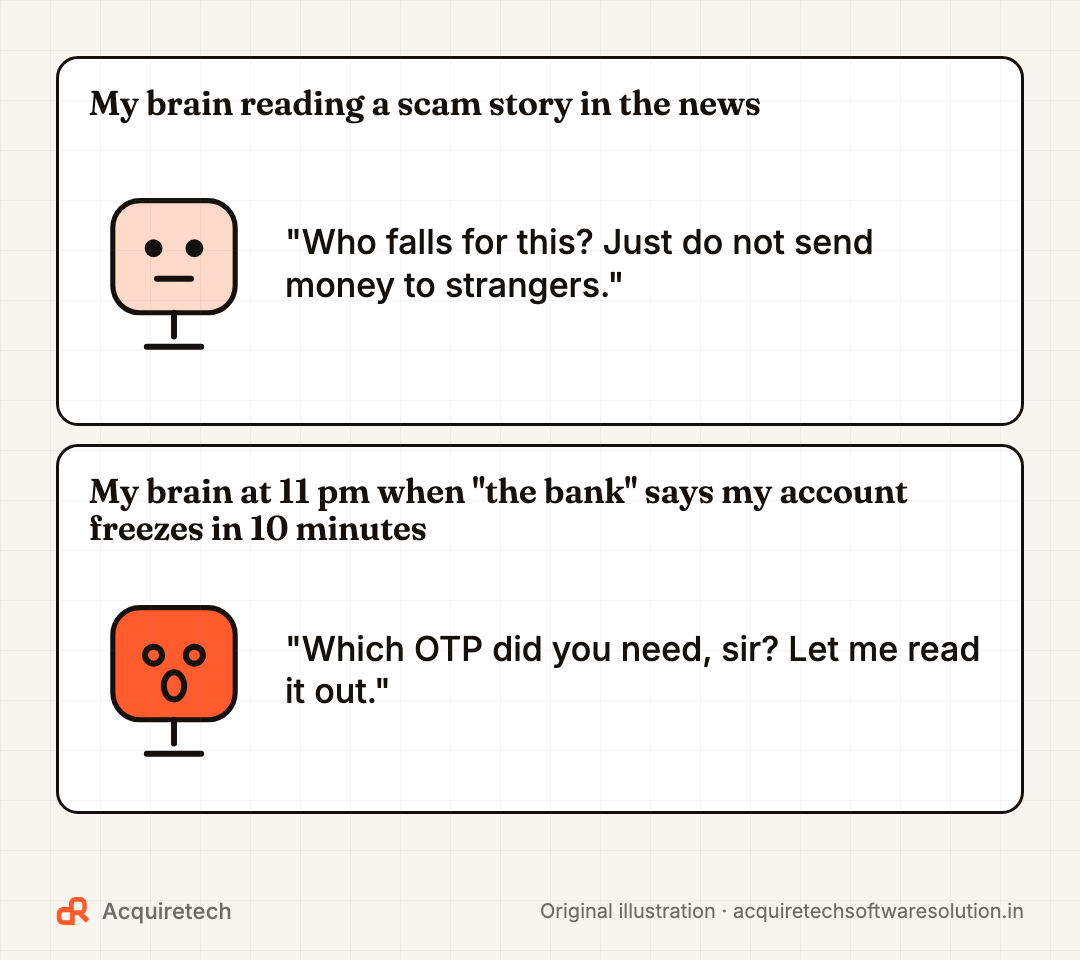
Why being smart can even work against you
This is our analysis rather than a single study, but the pattern fits the evidence above:
- You have more to take. Savings, investments and a good credit line make you worth a long, patient script.
- You trust your own judgement. "I would know a scam" is exactly the belief a scam is built around.
- You are busy. Professionals juggling meetings and messages run on autopilot more often, and cognitive load is a lever.
- Your expertise is narrow. A brilliant surgeon is not automatically an expert in crypto exchanges or police procedure.
The pause routine: five steps, about two minutes
The goal is to get back to a calm state before any money moves.
- Name the feeling. Say it out loud: "I am scared" or "I am excited". Strong emotion is your cue that a lever is being pulled.
- Break the clock. Real banks, police and courts do not resolve anything in ten minutes on a phone call. Say "I will call you back" and hang up.
- Break the isolation. Tell one person you trust, right now. Any request to keep it secret is the biggest red flag of all.
- Verify through a channel you choose. Call the number on your bank card or the official website, not the one in the message.
- Check the money direction. If anything asks for your PIN, OTP, biometric, screen share or a "refundable" transfer, money is about to leave you.
If money has already gone, call 1930 or report at cybercrime.gov.in immediately. Speed matters: as of 30 June 2026, the MHA says more than ₹11,158 crore had been saved through fast reporting.
Frequently asked questions
Why do intelligent people fall for scams?
Scams target emotional state rather than intelligence. Fear, excitement, urgency and secrecy push anyone into fast, automatic decisions, and a 2018 experiment found emotional arousal increased susceptibility to misleading offers in both younger and older adults.
Does education protect you from scams?
Only partly. A 2020 study of older Americans found financial literacy did not significantly predict investment fraud, while greater wealth did, and a 2022 experiment found fraud education worked but faded after three months without reminders.
Who loses the most money to scams in India?
Senior citizens tend to lose the most per case. In 2025, they filed about 1.03 lakh financial cyber fraud complaints involving ₹4,005 crore, an average of roughly ₹3.9 lakh per complaint, according to figures given to the Rajya Sabha.
What is the most common psychological trick scammers use?
Urgency is the most common, usually paired with authority or fear. Isolation, such as an instruction not to tell anyone, is the most dangerous because it removes the person most likely to spot the scam.
What should I do if I realise I have been scammed?
Call the 1930 cyber helpline or report at cybercrime.gov.in immediately, then call your bank to block the account or card. Fast reporting gives the system the best chance to freeze money before it moves on.
The bottom line
Falling for a scam is not proof of stupidity, and believing you are immune is part of the risk. The defence is a habit, not a higher IQ: notice the feeling, break the clock, tell someone, and verify on your own terms.
Share the pause routine with the people you love, especially the ones who are sure they would never fall for it. Then read our guide to fake job offers and interview scams, the lever-pulling script that targets students and job seekers.
Sources and further reading
- Dr. Robert Cialdini's Seven Principles of Persuasion · Influence at Work · 2026-11-09
- Emotional arousal may increase susceptibility to fraud in older and younger adults (Psychology and Aging) · PubMed Central · 2018-03-01
- Financial Fraud Among Older Americans: Evidence and Implications (Journals of Gerontology: Series B) · PubMed Central · 2020-03-01
- Can educational interventions reduce susceptibility to financial fraud? (Journal of Economic Behavior & Organization) · Elsevier / RePEc · 2022-06-01
- National Cyber Crime Data · Press Information Bureau (Ministry of Home Affairs) · 2026-07-21
- Over 1 Lakh Senior Citizens, 4.6 Lakh Women Hit by Cyber Fraud Worth Rs 7,769 Cr in 2025 · NewKerala (IANS) · 2026-08-05
- FTC Issues Annual Report to Congress on Agency's Actions to Protect Older Adults · US Federal Trade Commission · 2026-10-19
- FTC Testifies before the Joint Economic Committee on Agency's Efforts to Combat Fraud · US Federal Trade Commission · 2026-03-25
- New FBI Report: $20.9 Billion Lost to Internet Crimes in 2025, Older Adults Hit Hardest · AARP · 2026-04-16
- Over 100 'job fraud' websites promising quick money for 'work from home' blocked for 'laundering money' · ThePrint · 2023-12-06
Contact Acquiretech Software Solution: info@acquiretechsoftwaresolution.in · WhatsApp +91 80786 33912 · Send an enquiry