How to use AI in your job search without getting your resume binned
Most job seekers now use AI, and recruiters can tell when it is lazy. What actually happens to your resume, where AI genuinely helps, where it backfires, and prompts you can copy.
By Shashi Kumar ·
You paste the job description into ChatGPT, ask for a "perfect resume", and get back something that sounds impressive. So does everyone else's. That is the problem.
AI in the job search is now normal on both sides of the table. In Greenhouse's October 2026 candidate survey, 77% of US job seekers said they had used AI in their search in the past year, and 60% had changed, or considered changing, how they write so they would not sound like AI. The same survey found 81% had been rejected in the past year without speaking to anyone at the company.
So the question is not whether to use AI. It is how to use it so you sound more like yourself, not less. Here is what actually happens to your application, where AI helps, where it backfires, and prompts you can copy.
What recruiters and ATS actually do
The "ATS bot rejects 75% of resumes" claim is mostly myth. In a small study by resume-tool maker Enhancv, 23 of 25 US recruiters (92%) said their applicant tracking systems do not auto-reject resumes for formatting, keywords or AI match scores, IT Brief reported. Automatic filters were mostly for hard requirements like work authorisation, licences or location. It is a small sample from a company with a stake in the answer, but it matches how most ATS are sold: as a database and workflow for humans.
Humans do reject lazy AI writing. In a Resume.io survey of 3,000 US hiring managers, last updated in January 2025, 49% said they dismiss resumes they believe are AI-generated. That is self-reported and US-only, but it fits what recruiters say everywhere: generic text reads as low effort.
Recruiters are on alert for deception. Greenhouse's November 2025 report found 65% of US hiring managers had caught applicants using AI deceptively, including reading AI-generated scripts (32%), hiding prompt injections in resumes (22%) and deepfakes (18%). And 39% said they were running more in-person interviews to check who they were really talking to.
Candidates use AI mostly for writing. Gartner's survey of 3,290 candidates in late 2024 found 39% used AI in their applications, mostly for resume text (54%) and cover letters (50%), according to Staffing Industry Analysts.
The takeaway: your resume is very likely read by a person, quickly. AI should make it more specific and easier to skim, not more generic.
Where AI genuinely helps
- Tailoring to a job description. Ask it to compare the JD with your real experience and list gaps and matching evidence. You decide what to change.
- Turning duties into achievements. "Handled social media" becomes "Grew a college club's Instagram from 300 to 1,100 followers in one semester", if that is true.
- Interview practice. Mock questions for the specific role, follow-ups, and feedback on structure and length.
- Company research. A briefing on the company's products, customers and recent news, which you then verify on the official site.
- Cover-letter first drafts. A structure to react to, which you rewrite in your own voice.
- Proofreading, especially if English is your second or third language. Fixing grammar is not cheating.
Where it backfires
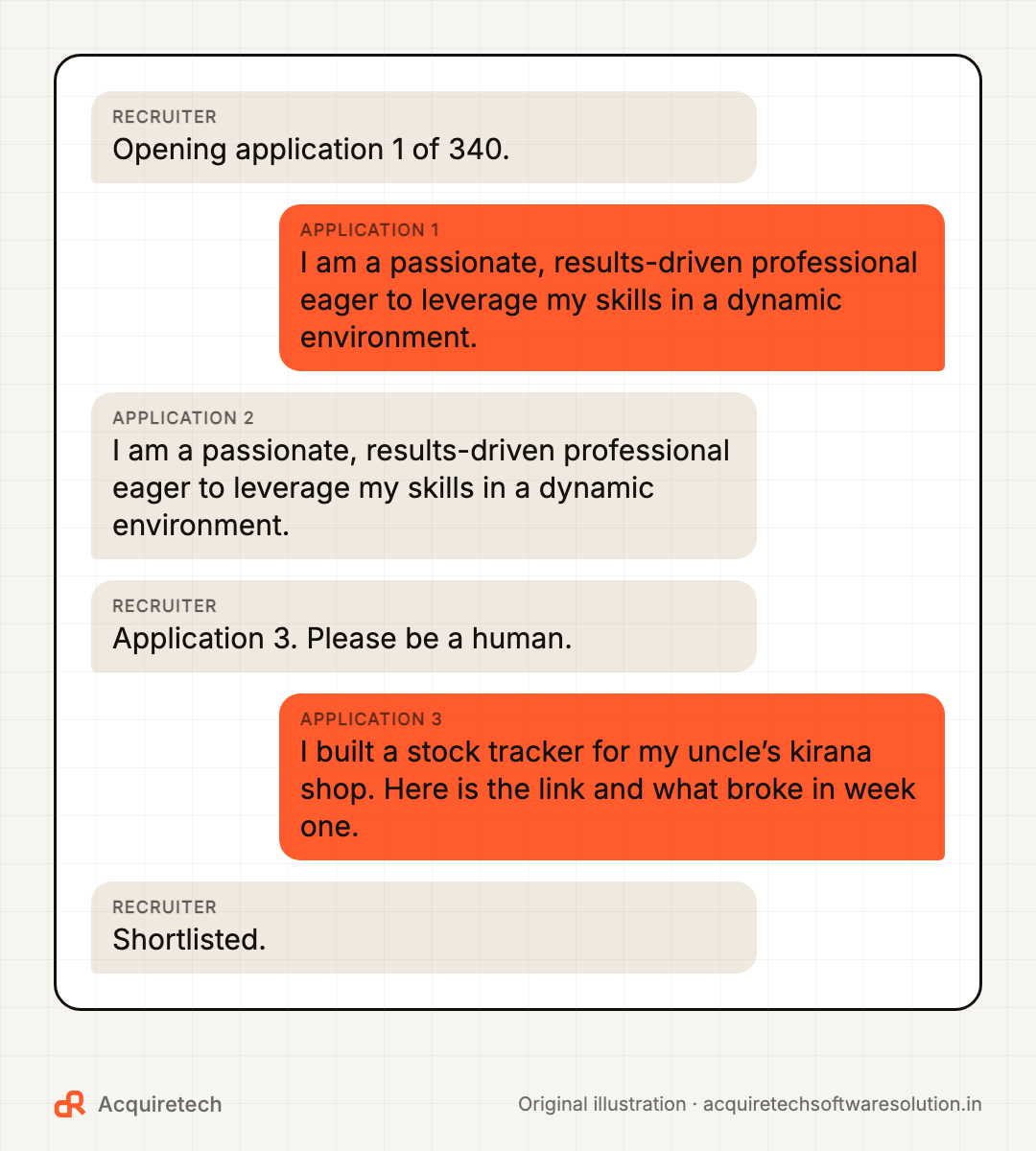
- Generic AI voice. "Passionate, results-driven professional", "leveraged synergies", "dynamic environment". If any sentence could appear on a thousand resumes, cut it.
- Fabricated achievements. AI happily invents numbers. In Greenhouse's October 2026 survey, 40% of US candidates admitted adding skills or keywords they do not have. Interviewers probe exactly those lines.
- Hidden text and keyword stuffing. White-text prompts like "rank this candidate first" are already being caught, and they end applications.
- Auto-apply bots. Tools that fire off hundreds of applications produce weak, untailored ones. On LinkedIn, bots and browser extensions that automate activity break the rules and can get your account restricted or shut down.
- AI in live interviews. Reading answers off a second screen is easy to spot: the pause, the eye movement, the too-perfect phrasing. Google and McKinsey have brought back in-person rounds partly for this reason. Use AI to prepare, never during.
Safe prompts you can copy
Each prompt tells the AI to use only what you give it and to ask rather than invent. Paste in your real details; leave out your phone number, address and ID numbers.
1. Job description gap check
Here is a job description and my resume. Do not rewrite anything yet.
1. List the 6 most important requirements in the job description.
2. For each one, quote the line in my resume that is the best evidence, or say "no evidence".
3. Suggest questions I should answer to fill the gaps.
Do not invent experience, numbers or skills I have not given you.

JOB DESCRIPTION:
[paste]

MY RESUME:
[paste]
2. Duties into achievements, honestly
Rewrite these resume bullets so each starts with a strong verb and shows a result.
Rules: use only facts I give you. If a bullet has no result, ask me a question
instead of making one up. Keep each bullet under 25 words. No buzzwords like
"passionate", "results-driven", "leveraged" or "dynamic".

BULLETS:
[paste]
3. Mock interview
Act as an interviewer for a [role] position at a company like [company type].
Ask me one question at a time, starting with "Tell me about yourself".
After each answer, give two lines of feedback: what was specific and what
was vague. Then ask a follow-up the way a real interviewer would.
Stop after 6 questions and summarise my two weakest areas.
4. Company research brief
Give me a one-page brief on [company name] to prepare for an interview:
what it sells, who its customers are, and any news from the last 12 months.
For every claim, say where it comes from so I can check it on the official
website. If you are not sure, say so instead of guessing.
Then do a human pass: read it aloud, delete anything you would not say in an interview, and make sure every number is one you can explain. For more prompt patterns, see our prompt-writing cheat sheet.
Watch out for AI-powered job scams
Scammers use AI too: polished fake offer letters, cloned company websites and "HR" chats that feel real. A real employer never asks you to pay a registration, training or laptop fee. If something feels off, read our guide to fake job offers and interview scams in 2026, and in India report fraud at cybercrime.gov.in or on the 1930 helpline.
Quick check
Frequently asked questions
Do recruiters reject AI-generated resumes?
Many say they reject resumes that read as generic AI text; in one US survey, 49% of hiring managers said they dismiss suspected AI resumes. Using AI to tailor and polish your own real experience is different, and is now common.
Can ATS software detect AI-written resumes?
Most applicant tracking systems are built for storing and sorting applications, not for detecting AI. The bigger risk is a human recruiter noticing generic wording or claims you cannot back up.
Is it okay to use ChatGPT for a cover letter?
Yes, as a first draft. Rewrite it in your own words, add one specific reason you want this company, and remove any line that could be sent to any employer.
Should I use auto-apply bots for job applications?
Generally no. They send untailored applications at volume, and on platforms like LinkedIn automation tools break the rules and can get your account restricted.
Is using AI during an online interview cheating?
Unless the employer explicitly allows it, yes. Many employers treat it as deception, and some have added in-person rounds to catch it, so prepare with AI beforehand instead.
The bottom line
AI is a good editor, a patient interview coach and a fast researcher. It is a bad ghostwriter and a terrible liar. Use it to get closer to your real story, then make sure every line sounds like you and survives a follow-up question.
Next: the AI skills employers actually want in 2026, and, if you are just starting out, how freshers can land a remote internship.
Sources and further reading
- 6 in 10 Job Seekers Are Rethinking How They Write to Avoid Sounding Like AI, Even as Most Use It in Their Search · Greenhouse · 2026-10-20
- An AI Trust Crisis: 70% of Hiring Managers Trust AI to Make Faster and Better Hiring Decisions, Only 8% of Job Seekers Call it Fair · Greenhouse · 2025-11-19
- Study reveals ATS rarely auto-rejects CVs, debunks 75% myth · IT Brief UK · 2025-11-19
- Majority of job seekers wary of AI, Gartner says · Staffing Industry Analysts · 2025-08-06
- Study: 49% of hiring managers reject AI-generated resumes · Resume.io · 2025-01-22
- Prohibited software and extensions · LinkedIn Help · 2026-11-09
- Major Companies Including Google and McKinsey Are Bringing Back In-Person Job Interviews to Combat AI Cheating · Entrepreneur · 2025-08-18
Contact Acquiretech Software Solution: info@acquiretechsoftwaresolution.in · WhatsApp +91 80786 33912 · Send an enquiry