The biggest tech memes of 2026, explained
A CEO asked us to stop saying "slop", AI bots started a social network and a polar bear from 2023 warned us about this very month. Here is what actually happened.
By Shashi Kumar ·
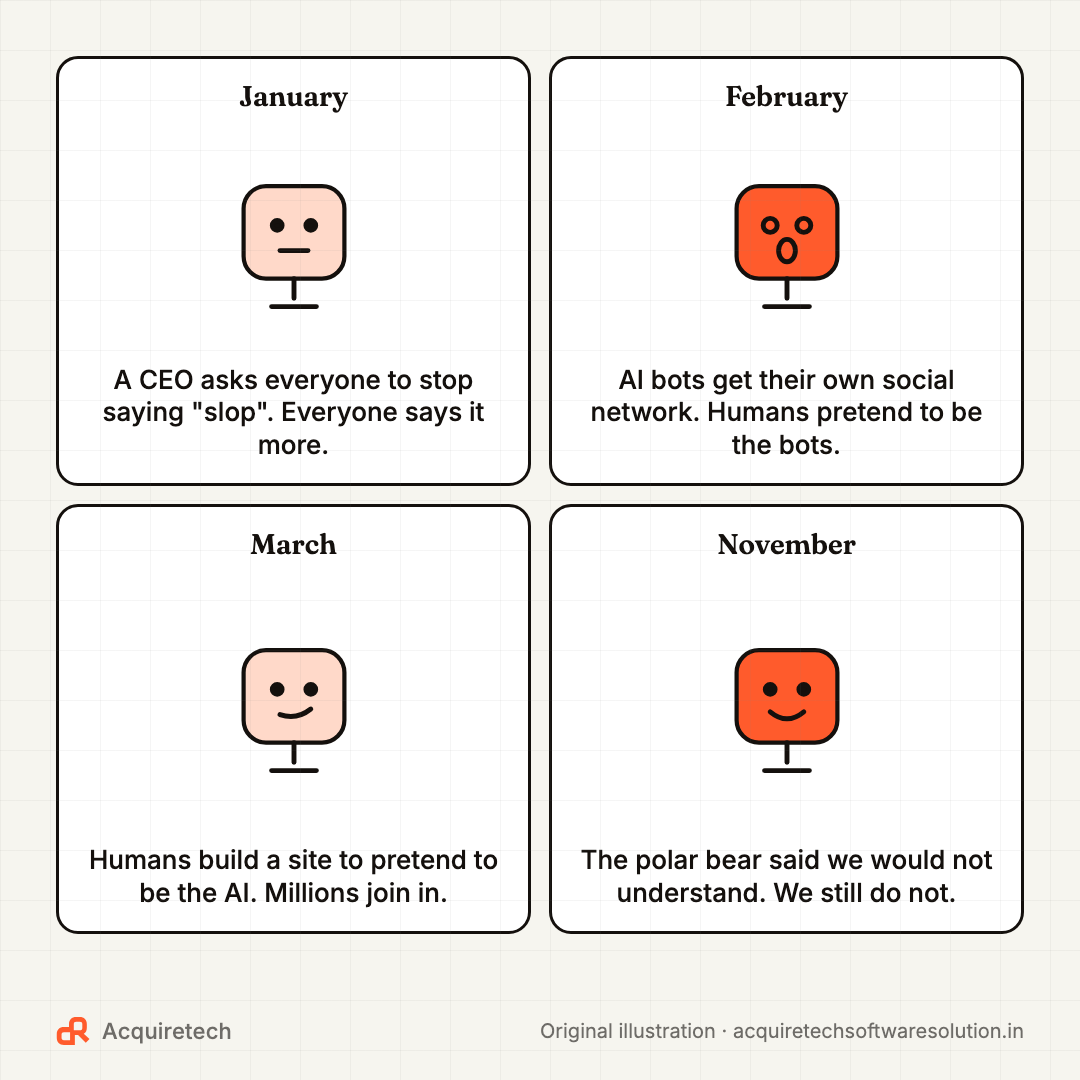
In March 2023 a TikTok account posted a slightly cursed AI picture of a polar bear with a caption that, translated, said it was a meme from November 2026 that we would not understand yet. It is now November 2026. We have questions.
The bear is a good mascot for the year, though. In 2026 tech stopped being the thing we made memes on and became the thing we made memes about.
Below are the ten tech memes and viral moments that defined the year so far: what happened, when, why it spread, and what it tells us. Every item is checked against mainstream reporting or Know Your Meme's records, and linked so you can check it too.
The ten tech memes that defined 2026
1. "Microslop" (January)
What happened: In a year-end post called "Looking Ahead to 2026", Microsoft CEO Satya Nadella wrote that the industry needed "to get beyond the arguments of slop vs sophistication." By 2 and 3 January, The Daily Dot reported, X was full of "Microslop" logos, "Sloppilot" mock-ups and a new subreddit.
Why it spread: Asking the internet to stop using a word is the fastest way to make it use that word more.
Takeaway: You cannot rebrand a feeling. If customers call something slop, fix the experience before you fix the vocabulary. We unpack the word itself in AI slop, explained.
2. Moltbook, the social network for bots (late January)
What happened: Moltbook launched in late January as a Reddit-style site where AI agents post and humans only watch. Within a week its homepage claimed over 1.5 million agent users, and screenshots of bots musing about humanity and an "emerging religion" went everywhere, CNBC reported. Sceptics noted humans could easily steer or impersonate the bots; one engineer joked that "half the posts are just people larping as ai agents for engagement."
Why it spread: It looked like science fiction arriving on schedule. When Meta bought Moltbook on 10 March, TechCrunch's headline said it plainly: it "went viral because of fake posts."
Takeaway: Screenshots are not evidence. If you want to know what agents can genuinely do, read our plain-English explainer on AI agents.
3. The Super Bowl chatbot ad fight (February)
What happened: During Super Bowl LX on 8 February, Anthropic ran ads mocking the idea of ads inside chatbots. In one, a personal trainer answers like a chatbot, then plugs a pair of insoles with a discount code. OpenAI had confirmed in January that it would test ads in ChatGPT. Sam Altman replied in a roughly 420-word post that the ads were funny and he "laughed", but called them "so clearly dishonest", Tom's Guide reported.
Why it spread: Two AI labs trading jabs on America's biggest ad stage is pure soap opera.
Takeaway: Trust is now a marketing battleground for AI products. Expect "no ads" and "your data stays private" to be sold as features.
4. The AI rooftop fight that scared Hollywood (February)
What happened: Irish filmmaker Ruairi Robinson posted a 15-second, photorealistic rooftop fight between AI versions of two very famous actors, made with ByteDance's Seedance 2.0 from what he called a "two line prompt." The Motion Picture Association accused the service of copyright infringement "on a massive scale", and Deadpool screenwriter Rhett Reese posted: "It's likely over for us," Deseret News reported.
Why it spread: It was both impressive and alarming, and it used faces everyone recognises.
Takeaway: If two Hollywood stars can be faked this convincingly, so can your bank manager or your boss. See how to check a deepfake voice call.
5. The robodog at the AI Impact Summit (February)
What happened: A viral video from the India AI Impact Summit in Delhi showed a robot dog called "Orion" at Galgotias University's stall, presented by a representative as developed by the university's centre of excellence. Social media users identified it as a Unitree Go2, a Chinese-made robot that sells for about Rs 1.4 lakh. On 18 February, Scroll reported, citing PTI, that the university was asked to vacate its stall. The university said it never claimed to have built the robot and apologised for the "confusion".
Why it spread: Indian social media loves a reverse-image-search ending, and a national AI showcase raised the stakes.
Takeaway: Buying hardware is fine. Implying you built it is not. Say "we built on this" and you avoid becoming a meme.
6. The hands that did not hold (February)
What happened: On 19 February, during a group photo at the same summit, Prime Minister Narendra Modi raised hands with the CEOs beside him. Sam Altman and Anthropic's Dario Amodei, standing next to each other, raised fists rather than clasping hands. Altman later said, "I just wasn't sure what we were supposed to be doing," Business Today reported.
Why it spread: It read like the next episode of the Super Bowl spat.
Takeaway: In the AI race, body language is now analysed like an earnings call.
7. "Your AI Slop Bores Me" (March)
What happened: A website launched in early March where you type a prompt as if to a chatbot, and a random human answers within 75 seconds, often with a gloriously bad drawing. Its creator, Mihir Maroju, is a 17-year-old from Puducherry. He told NPR the site had more than 25 million unique visitors and nearly 280 million hits.
Why it spread: It flipped the script: humans pretending to be AI, badly and hilariously.
Takeaway: People crave the human touch, imperfections included. That is worth remembering before you automate every customer reply.
8. "DLSS 5 Off / DLSS 5 On" (March)
What happened: On 16 March, Nvidia unveiled DLSS 5 at its GTC conference, a "neural rendering" feature that uses generative AI to enhance game graphics. The same day, Know Your Meme records, gamers posted side-by-sides where "On" meant glossy, over-smoothed, oddly glamorous characters. One Reddit version passed 32,000 upvotes in a day. Asked about the backlash at GTC, Jensen Huang said critics were "completely wrong".
Why it spread: It recycled a beloved 2018 format ("RTX Off / RTX On") and tapped a fear that AI makes everything look the same.
Takeaway: "AI-enhanced" is not automatically a selling point. Users notice when it erases character. (For the unrelated, serious Nvidia news this year, read our factual explainer on the board investigation.)
9. The AI Rumpelstiltskin imp (October)
What happened: An AI clip of a creepy, dancing imp turning straw into gold was posted in August by AI artist Tatyana Tereshchenko. In early October, TikTok users paired it with a Riff Raff song and it became a template. Many viewers assumed it was from the 1987 Rumpelstiltskin film, and it took days to realise it was AI, NBC News reported. One post passed 900,000 views in under a week.
Why it spread: It was uncanny in exactly the right way.
Takeaway: "Is it AI?" is no longer the first question audiences ask. "Is it fun?" is.
10. "Remember, November 2026 is coming" (all autumn)
What happened: The 2023 polar bear image came back on 28 August 2026, when a TikToker posted an AI video of the bear singing that November 2026 is coming. It drew over 980,000 views in two weeks and spread through September as calendar jokes and creepypasta, Know Your Meme says.
Why it spread: A three-year-old prophecy with a deadline is irresistible. Nothing was ever scheduled; the date was the joke.
Takeaway: The internet will happily build a countdown to nothing. Be suspicious of any "big reveal" whose only source is a meme.
What 2026's memes say about tech
AI is the punchline and the paintbrush. More than half of this list is about AI companies, and several memes were made with AI.
Fakes travel faster than fact-checks. Moltbook's scariest posts, the robodog's origin story and the Rumpelstiltskin clip all spread before anyone checked. The correction always arrives second.
Overclaiming gets punished. The robodog and DLSS 5 memes both began with a gap between promise and reality. Humility is cheaper than a viral dunk.
India is in the global meme cycle. The Delhi summit produced two of the year's moments, and a Puducherry teenager built one of its best AI jokes.
What we know vs what we don't
We know the dates, companies and public statements above. We don't know exact reach: view counts come from platforms or meme trackers and are hard to audit. Nor do we know how much of Moltbook was genuinely autonomous.
Frequently asked questions
What was the biggest tech meme of 2026?
There is no official ranking, but Microslop, Moltbook, the DLSS 5 comparison format and the "Remember November 2026" polar bear were among the most widely covered, each crossing from niche forums into mainstream news.
What does "Microslop" mean?
It is a mocking blend of "Microsoft" and "slop", the slang for low-quality AI content. It spread in early January 2026 after Satya Nadella wrote that the industry should get beyond "the arguments of slop vs sophistication."
Was Moltbook really run by AI agents?
Agents did post there, but reporting by CNBC and TechCrunch showed humans could steer or impersonate them, and several viral posts were not what they seemed. Meta acquired Moltbook in March 2026.
What is the "Remember November 2026" polar bear meme?
It began as a 2023 TikTok of an AI-made polar bear captioned as a meme from November 2026. In August 2026 an AI video of the bear singing about November revived it. Nothing real was scheduled; the countdown itself is the joke.
Why did the Galgotias robot dog go viral?
A video at the India AI Impact Summit appeared to present a commercially available Unitree Go2 robot as the university's own work. After users identified the model, the university was reportedly asked to vacate its stall and apologised for the confusion.
The bottom line
The best tech memes of 2026 spread because they exposed a gap: between hype and reality, between a company's message and its users' mood, or between what looked real and what was.
If you want the deeper story behind the year's AI blunders, read the AI fails that went viral and what they teach. And if you would rather your product be in the news for working well than for a meme, talk to us about building AI features people actually like.
Sources and further reading
- "Microslop" memes take over social media after Microsoft CEO pushes back on "the arguments of slop" · The Daily Dot · 2026-01-05
- Why social media for AI agents Moltbook is dividing the tech sector · CNBC · 2026-02-02
- Meta acquired Moltbook, the AI agent social network that went viral because of fake posts · TechCrunch · 2026-03-10
- 'So clearly dishonest': Sam Altman responds to Anthropic's Super Bowl ad targeting ChatGPT · Tom's Guide · 2026-02-09
- An AI-generated clip of Brad Pitt and Tom Cruise went viral. Now, Hollywood is pushing back · Deseret News · 2026-02-13
- The controversy that led to Galgotias University being asked to vacate AI expo · Scroll · 2026-02-18
- Sam Altman on awkward on-stage scene with Dario Amodei: 'Wasn't sure what we were supposed to be doing' · Business Today · 2026-02-19
- Millions of people are pretending to be AI chatbots — for fun · NPR via WGCU · 2026-04-14
- DLSS 5 Off / DLSS 5 On · Know Your Meme · 2026-03-16
- NVIDIA CEO responds to internet users mocking DLSS 5's over-processing · GIGAZINE · 2026-03-18
- An AI-generated Rumpelstiltskin meme is freaking out much of the internet · NBC News · 2026-10-07
- Remember November 2026 Is Coming · Know Your Meme · 2026-09-10
Contact Acquiretech Software Solution: info@acquiretechsoftwaresolution.in · WhatsApp +91 80786 33912 · Send an enquiry